Pakistan Just Widened the Digital Road. But Who Gets to Drive?

What the 2026 spectrum auction means for Pakistani students, professionals, and the digital divide
The Headline Is Real — and Worth Understanding
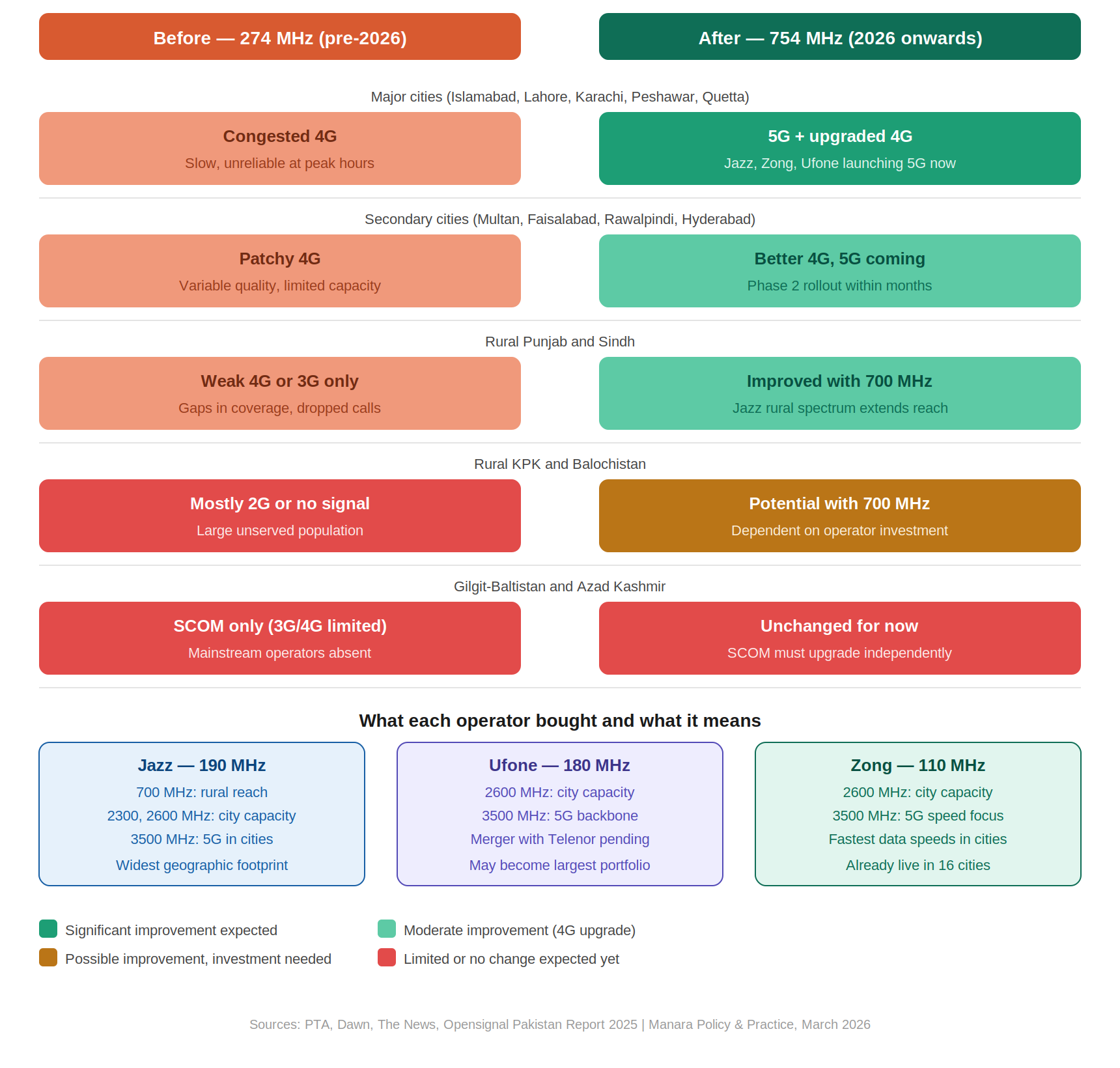
Pakistan just did something significant. In March 2026, the government auctioned 480 MHz of radio spectrum to three telecom operators, Jazz, Zong, and Ufone, for $507 million, nearly tripling the country's total available spectrum from 274 MHz to 754 MHz (PTA, 2026). Officials described it as possibly the world's largest single-round spectrum auction (Daily Business News, 2026).For most people, that sentence is full of words that mean nothing. So here is a plain version.Your phone connects to the internet through invisible radio signals travelling between your device and a cell tower. The government controls how much of that invisible space each telecom company can use. Until last month, Pakistan had been operating on the same cramped allocation since 1997. The IT Minister described the situation as "running an eight-lane vehicle on a two-lane road" (Dawn, 2026). The auction was the government finally widening the road.But roads only matter if people can get on them.
What Actually Changed, and for Whom
The spectrum was sold across four frequency bands, and each band behaves differently. This matters for understanding who benefits first.The 700 MHz band travels long distances and passes through walls and terrain. It is suited for rural coverage. Jazz, Pakistan's operator with the widest geographic footprint, specifically purchased spectrum here (The News, 2026). The 2300 MHz and 2600 MHz bands carry more data in densely populated areas. The 3500 MHz band is the primary 5G band, fast and powerful but short-range, suited to cities.In the immediate aftermath of the auction, Zong announced it had commercially launched 5G services in more than 16 cities, including Islamabad, Rawalpindi, Karachi, Lahore, Peshawar, and Quetta (Dawn, 2026). Jazz announced that in the first phase of its 5G rollout, services were being provided across 180 sites in Islamabad, all four provincial capitals, as well as Rawalpindi, Multan, and Faisalabad (Dawn, 2026).For the average person in those cities, improved 4G quality is the more immediate benefit. The IT Minister said consumers would see significantly better 4G services within four to five months (Dawn, 2026). That means faster loading, fewer dropped video calls, and more reliable connections during peak hours.For people outside those cities, the picture is more complicated.
The Geography of Who Gets Left Behind
According to Opensignal's Pakistan Mobile Network Experience Report, Jazz wins the Coverage Experience award with the widest geographic footprint in populated areas, and also holds the highest 4G availability at 93.5 percent (Opensignal, 2025). Zong remains the champion of pure data speed performance, averaging 17.3 to 22.4 Mbps download speeds, with the lowest latency, making it the preferred choice for urban heavy data users (Opensignal, 2025).The pattern this reveals is consistent. Better connectivity in cities. Thinner, less reliable coverage as you move outward. The auction does improve the foundations for rural reach, particularly through Jazz's 700 MHz purchase. But spectrum alone does not build towers. Operators must now choose where to invest in physical infrastructure, and historically that investment has followed population density and purchasing power.Then there is Gilgit-Baltistan. SCOM, the Special Communication Organisation network, provides the only dedicated 3G and 4G coverage in Gilgit-Baltistan and Azad Kashmir (SCOM, 2025). Jazz, despite buying the band specifically designed for rural and mountainous terrain, does not operate in GB. The 2026 auction changes nothing there unless SCOM independently upgrades its network to match the national pace. As connectivity upgrades roll out nationwide, the question worth asking is whether SCOM will keep up.This is not an abstract concern. GB is home to some of Pakistan's most talented young people, to communities already navigating climate vulnerability and economic marginalisation, and to students for whom reliable internet access is the difference between participating in the digital economy and being excluded from it.
What This Means for You, Specifically
If you are a student in a major city, you will feel this within months. Video lectures will buffer less. Online assessments will be more reliable. As 5G expands, cloud-based tools and AI-assisted learning platforms will become genuinely usable on mobile, not just on fixed broadband.If you are a freelancer or remote professional, better 4G and coming 5G means faster upload speeds, more stable video calls, and the ability to work from a broader range of locations without sacrificing productivity. Pakistan already ranks among the top freelancing countries globally (The News International, 2025). Better connectivity raises the ceiling on the quality of work that can be delivered.If you are a business owner in a secondary city, the timeline is less certain. Phase two of the 5G rollout will reach you, but the schedule depends on operator investment decisions that have not been publicly committed.If you live in a rural area or in GB, the auction is a step, not an arrival. The spectrum exists. The political will, for once, appeared. Whether the last mile of delivery reaches you depends on regulatory pressure, infrastructure investment, and in GB's case, whether SCOM is resourced and motivated to modernise.
The Question No One Is Asking Loudly Enough
Pakistan's digital ambitions are real and accelerating. The spectrum auction, the establishment of the Pakistan Digital Authority, the National AI Policy, the commitment to train a million people in digital skills by 2027 (Arab News, 2025), these are not small gestures. They reflect a government that understands, at least rhetorically, that connectivity is infrastructure in the same way roads and electricity are infrastructure.But infrastructure investment has historically widened inequality in Pakistan before it eventually narrows it. The first beneficiaries of better roads were those with vehicles. The first beneficiaries of reliable electricity were those already connected to the grid. The risk with this spectrum auction is the same. Those already connected will get faster and more reliable connections. Those on the margins, rural communities, mountain regions, people without 4G-capable devices, may find the gap between their experience and the national headline growing wider, not narrower.Pakistan has over 190 million mobile phone users, but most networks currently operate on 4G infrastructure, and the rollout of 5G has faced delays in recent years due to regulatory, economic, and spectrum constraints (Arab News PK, 2026). Closing those delays was necessary. It was not sufficient.The operators who purchased this spectrum have obligations. The government that sold it has obligations too. Equitable rollout, quality of service standards in underserved areas, and genuine investment in connectivity as a public good rather than purely a commercial product are what will determine whether this auction is a turning point for all of Pakistan, or only for the parts already moving forward.A wider road means nothing if some people are still not allowed on it.
Manara Policy and Practice is a strategic design and advisory practice working at the intersection of evidence, equity, and action. This Desk Note is part of our series translating policy developments into accessible analysis for Pakistani students, professionals, and practitioners.
References
Arab News. 2025. "Pakistan Unveils National AI Policy to Boost Innovation, Jobs and Ethical Governance." August 13. https://www.arabnews.com/node/2611685/pakistanArab News PK. 2026. "Pakistan Sells 480 MHz for $507 Million in 5G Spectrum Auction." March. https://www.arabnews.pk/node/2635931/pakistanDaily Business News. 2026. "Pakistan Conducts 'World's Largest' Spectrum Auction: Shaza." March. https://www.dailybusinessnews.pkDawn. 2026. "Faster, Cheaper, Better: 480 MHz Sold for $507m as 5G Spectrum Auction Concludes." March. https://www.dawn.com/news/1980473Opensignal. 2025. Pakistan Mobile Network Experience Report, February 2025. https://insights.opensignal.com/reports/2025/02/pakistan/mobile-network-experiencePakistan Telecommunication Authority (PTA). 2026. Spectrum Auction Results Announcement. March. https://www.pta.gov.pkSCOM. 2025. Internet Packages for Gilgit-Baltistan and Azad Kashmir. https://exploreskardu.com/scom-internet-packages-gilgit-baltistan-azad-kashmir-2024-2025/The News International. 2025. "Bridging the Skills Gap." March. https://www.thenews.com.pk/tns/detail/1336333-bridging-the-skills-gapThe News International. 2026. "Pakistan Raises $507m in 5G Spectrum Auction." March. https://www.thenews.com.pk/print/1403887